

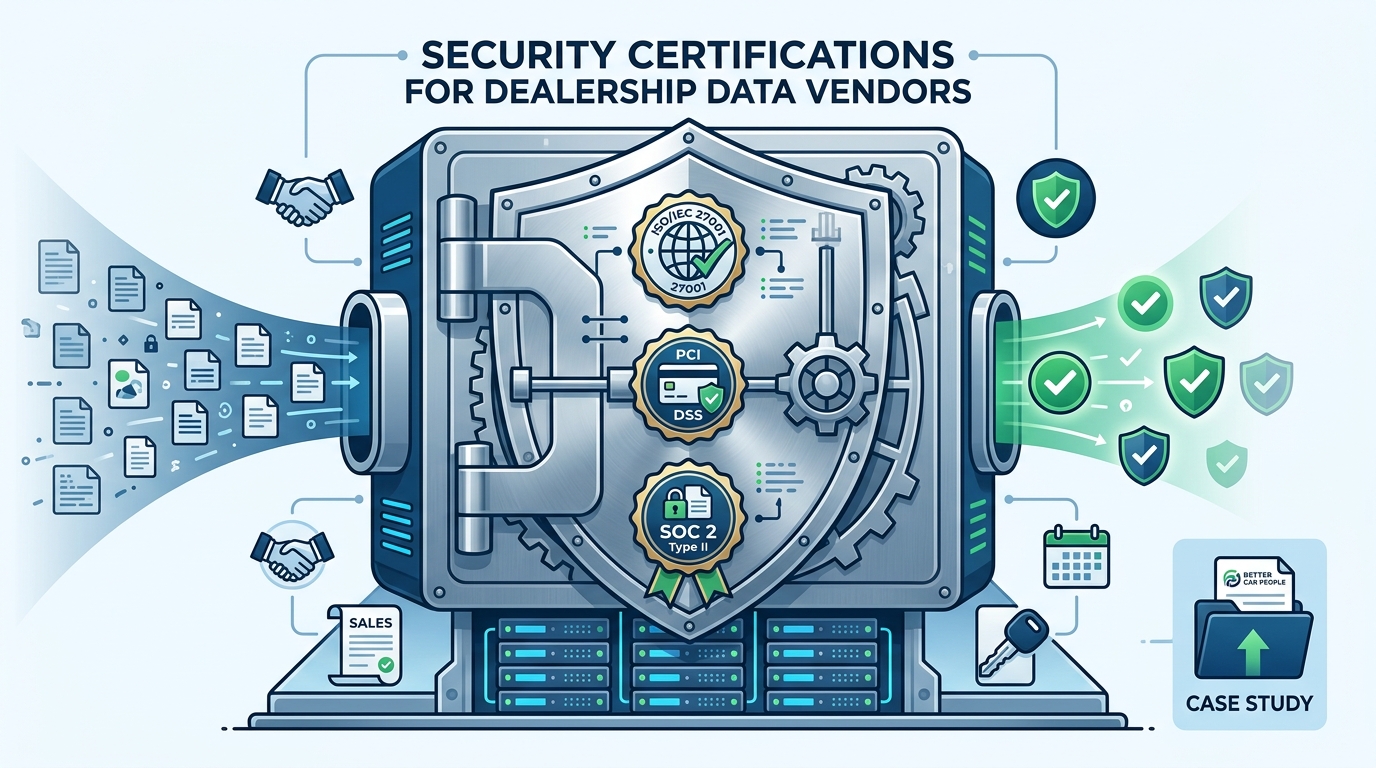
Dealerships must require ISO/IEC 27001, PCI DSS, and SOC 2 Type II certifications from vendors handling customer data. These standards ensure robust data protection, regulatory compliance, and operational transparency. This guide details the specific security frameworks, contractual safeguards, and ongoing assessment protocols necessary to protect dealership assets and customer trust in 2026. For additional details, review the Case Studies Better Car.
ISO/IEC 27001 Certification
ISO/IEC 27001 is the international standard for information security management systems (ISMS). It provides a systematic approach to managing sensitive customer information, ensuring it remains secure. For automotive dealerships, this certification is the baseline for any vendor accessing customer records, financial data, or vehicle history. For additional details, review the Customer Support Better Car.
Scope and Applicability
When evaluating a vendor, verify that their ISO/IEC 27001 certificate covers the specific services they provide to your dealership. A certificate for a general software platform may not cover the specific data processing pipelines used for dealership integrations. The standard requires organizations to identify information security risks and implement controls to mitigate them. For additional details, review the What 25 Years of.
Control Objectives
PCI DSS Compliance
PCI DSS is a global security standard designed to protect cardholder data. Any vendor that stores, processes, or transmits credit card information on behalf of a dealership must be PCI DSS compliant. This is non-negotiable for protecting payment transactions and avoiding liability. For additional details, review the Service BDC Better Car.
Service Provider vs. Merchant
Attestation of Compliance
Request the vendor's Attestation of Compliance (AoC) document. This document confirms that the vendor has undergone a security assessment by a Qualified Security Assessor (QSA). The AoC should be current and cover the specific environment where your dealership's data is processed. For additional details, review the Service to Sales Better.
Vendor Contract Safeguards
Security certifications are necessary but not sufficient. Contracts must explicitly define data handling responsibilities, breach notification procedures, and liability. A robust vendor agreement protects the dealership in the event of a security incident.
Data Processing Agreements
Breach Notification and Liability
Contracts must mandate immediate notification of any security breach, typically within 24 to 72 hours. Define the vendor's liability for data breaches, including indemnification clauses that cover costs associated with notification, credit monitoring, and legal fees.
Ongoing Vendor Assessment
Continuous Monitoring
Utilize tools that provide real-time visibility into vendor security posture. Monitor for changes in the vendor's security certifications, new vulnerabilities, or changes in their data processing practices. Continuous monitoring helps identify risks before they become incidents.
Periodic Audits
Key Takeaways
- Require ISO/IEC 27001 certification for all vendors handling customer data.
- Ensure PCI DSS compliance for any vendor processing payment information.
- Mandate immediate breach notification in all vendor agreements.
- Implement continuous monitoring of vendor security posture.
- Conduct periodic audits to verify ongoing compliance.
- Verify that certification scope covers specific dealership services.
- Define clear liability and indemnification clauses for data breaches.
Frequently Asked Questions
What is the difference between ISO/IEC 27001 and SOC 2?
ISO/IEC 27001 is an international standard for information security management, while SOC 2 is a US-focused framework for service organizations. Both are valuable, but ISO/IEC 27001 is more globally recognized.
How often should I review vendor security certifications?
Review certifications annually or whenever the vendor notifies you of changes. Continuous monitoring tools can help track real-time changes in security posture.
What should I do if a vendor does not have ISO/IEC 27001?
Assess their alternative security controls and risk profile. If they handle sensitive data, consider requiring them to obtain certification or implement compensating controls.
Are there specific PCI DSS requirements for service providers?
Yes, service providers must comply with PCI DSS requirements specific to their role, including regular security assessments and vulnerability scans.
How can I verify a vendor's PCI DSS compliance?
Request their Attestation of Compliance (AoC) document and verify it with the PCI Security Standards Council.