

How BDC and AI Platforms Integrate with Dealership CRM and DMS
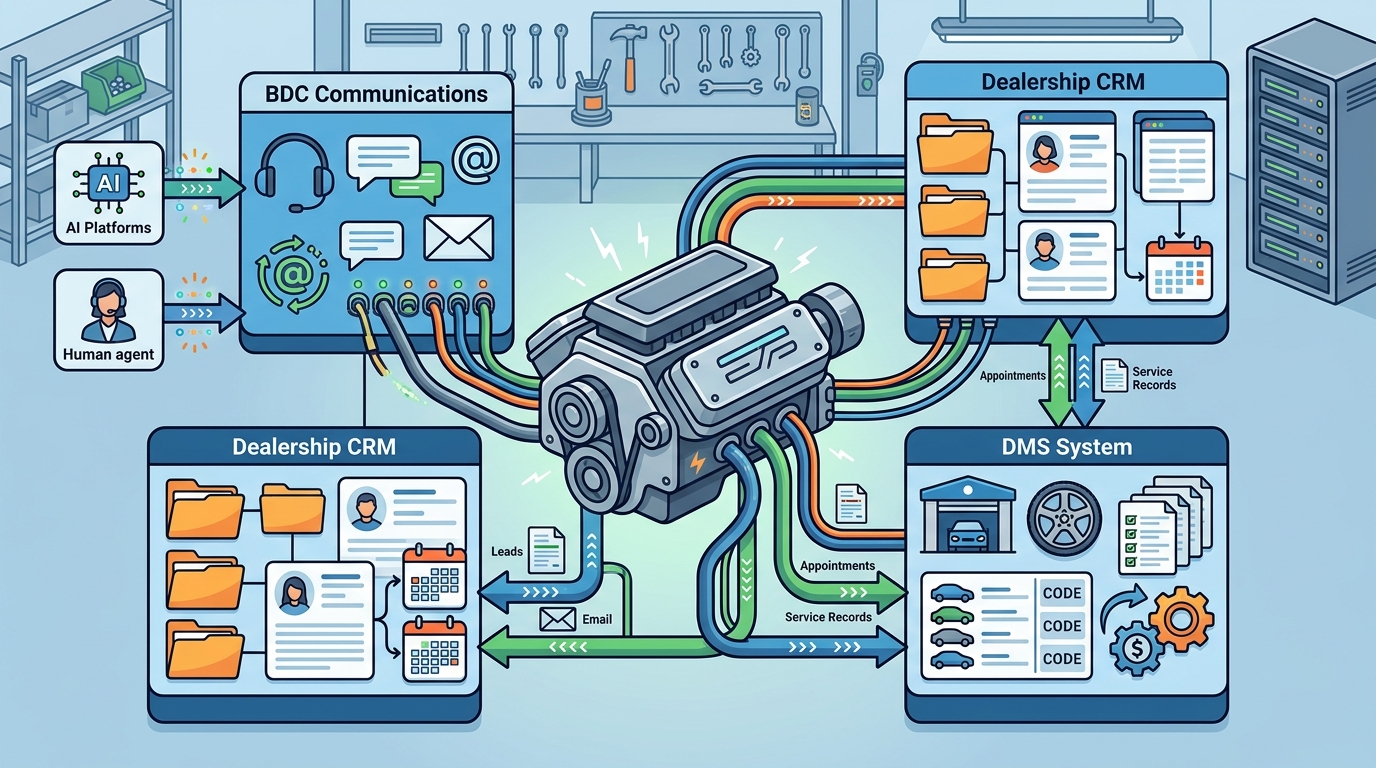
BDC and AI platforms integrate with dealership CRM and DMS systems through API connections, middleware, and data synchronization protocols. These integrations ensure that lead data, appointment schedules, and customer interactions flow seamlessly between communication channels and core dealership software. This connectivity allows sales and service teams to access real-time customer history, reducing manual data entry and improving response times. Better Car People designs its collaborative intelligence engine to work within these existing ecosystems, ensuring that AI and human agents operate with full context from your current infrastructure.
The Role of Middleware in Data Synchronization
Middleware acts as the bridge between disparate dealership systems, translating data formats so that CRM and DMS platforms can communicate effectively. Without this layer, data often remains siloed, leading to duplicate entries and outdated customer profiles. Middleware ensures that when a customer interacts via text or chat, the resulting data is immediately reflected in the DMS. This synchronization is critical for maintaining a single source of truth across the dealership.
For example, when a service appointment is booked through an AI chatbot, the middleware pushes this event directly into the DMS scheduling module. This eliminates the need for a service advisor to manually re-enter the appointment. The result is a streamlined workflow where the DMS remains the authoritative record of all customer interactions and vehicle histories.
API Connections and Real-Time Data Flow
Application Programming Interfaces (APIs) enable direct, real-time communication between BDC platforms and dealership software. These connections allow for the instant retrieval of customer data, such as vehicle service history and previous purchase details, during live conversations. Real-time data flow ensures that agents and AI systems have the most current information available at the moment of contact.
Consider a scenario where a customer calls to inquire about a specific vehicle. The BDC platform queries the DMS via API to check inventory status and pricing in real-time. This immediate access allows the agent to provide accurate quotes without leaving the call. Such efficiency is a hallmark of modern dealership technology, where speed and accuracy are paramount.
Challenges in Legacy System Integration
Many dealerships operate on legacy DMS systems that lack modern API capabilities, presenting significant integration challenges. These older systems often rely on file-based data transfers or limited connectivity options, which can slow down data synchronization. Overcoming these hurdles requires robust middleware solutions that can handle complex data mapping and error handling.
For instance, a dealership using a DMS from the early 2000s may need a specialized connector to interface with a modern AI platform. This connector must map legacy data fields to modern CRM structures, ensuring that no critical information is lost during the transfer. Addressing these technical gaps is essential for achieving a fully integrated digital ecosystem.
Impact on Customer Experience and Operational Efficiency
Seamless integration between BDC, AI, CRM, and DMS systems significantly enhances the customer experience by providing consistent and personalized interactions. When data flows freely, customers receive responses that reflect their full history with the dealership, fostering trust and loyalty. Operationally, this integration reduces the administrative burden on staff, allowing them to focus on high-value tasks.
For example, a sales agent can view a customer's service history and preferences instantly, enabling a more tailored sales pitch. This level of personalization is difficult to achieve without robust system integration. The operational efficiency gains also translate to cost savings, as fewer hours are spent on manual data entry and reconciliation.
Best Practices for Successful Integration
Better Car People emphasizes the importance of collaborative intelligence in this process, ensuring that both AI and human agents benefit from integrated data. By following these best practices, dealerships can build a resilient technology stack that supports growth and customer satisfaction. For additional details on how these integrations work, review the Better Car People integrations page. according to Collaborative intelligence Wikipedia
Key Takeaways
- Middleware is essential for translating data between CRM and DMS systems.
- APIs enable real-time data flow, ensuring immediate access to customer history.
- Legacy systems require specialized connectors to interface with modern AI platforms.
- Integration enhances customer experience through personalized and consistent interactions.
- Operational efficiency improves as manual data entry is reduced.
- A clear integration strategy and experienced partners are key to success.
Frequently Asked Questions
What is a BDC in the automotive industry?
A BDC, or Business Development Center, is a team of agents who handle inbound and outbound communications to generate sales and service appointments.
How does AI integrate with a DMS?
AI integrates with a DMS through APIs and middleware, allowing it to access and update customer and vehicle data in real-time.
What is the role of middleware in dealership systems?
Middleware acts as a bridge between different software systems, translating data formats to ensure seamless communication.
Can legacy DMS systems integrate with modern AI platforms?
Yes, legacy DMS systems can integrate with modern AI platforms using specialized connectors and robust middleware solutions.
Why is real-time data flow important for BDCs?
Real-time data flow is important because it allows BDC agents to access the most current customer information during live interactions.
How does integration improve customer experience?
Integration improves customer experience by enabling personalized and consistent interactions based on a complete customer history.