

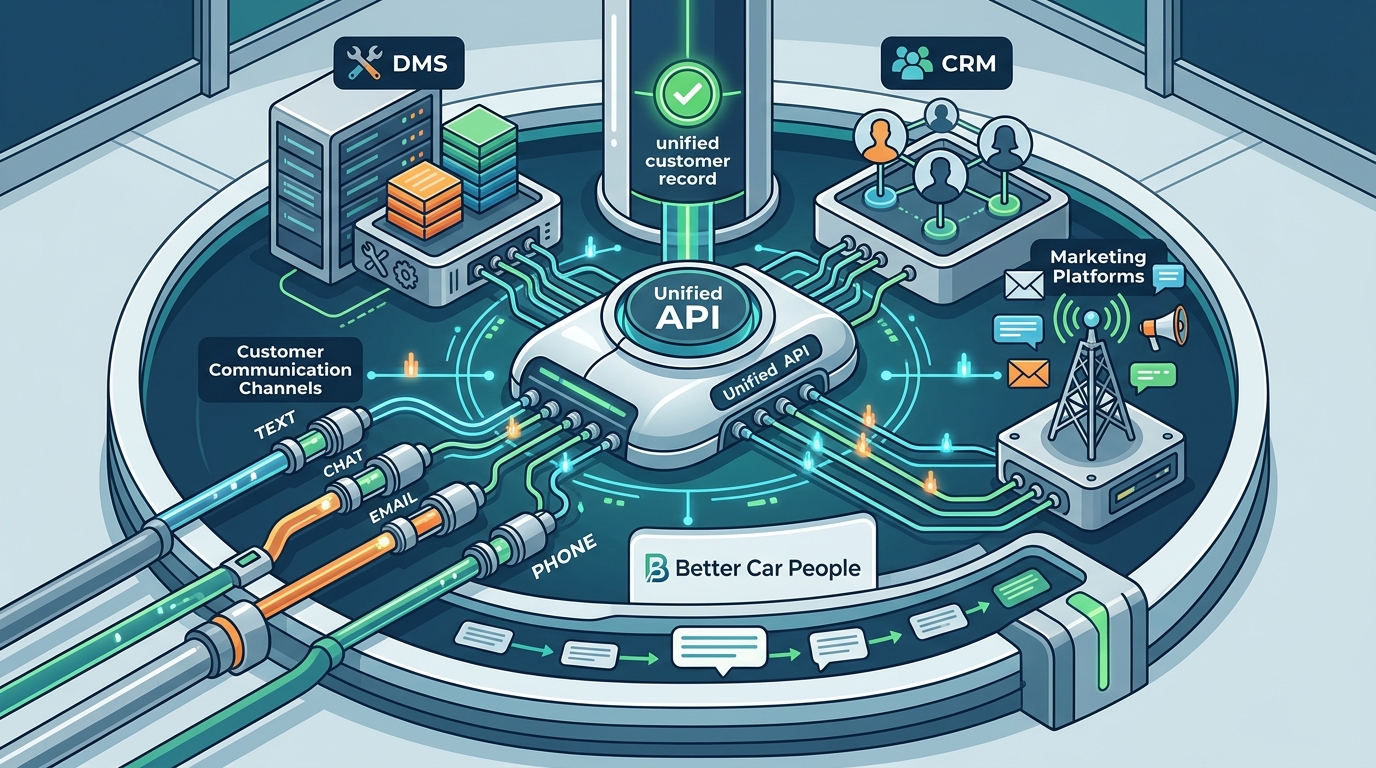
The best way to connect dealership systems with AI-powered customer engagement tools is through a unified API layer that synchronizes your DMS, CRM, and marketing platforms in real time. This architecture ensures that every customer interaction, whether via text, chat, or phone, updates the central customer record instantly. Better Car People designs these integrations to eliminate data silos, allowing your team to see a complete customer history before they even pick up the phone. This seamless connection is the foundation of modern dealership growth.
Building a Unified Data Architecture
Consider a scenario where a customer submits a service request via an AI chatbot. Without proper integration, that request might sit in a marketing inbox while the service department remains unaware. With a unified data layer, the AI tool pushes the request directly into the DMS service module. The service advisor sees the alert immediately, and the customer receives a confirmation text. This speed and accuracy are critical for maintaining high customer satisfaction scores.
The Role of APIs and Middleware
Application Programming Interfaces, or APIs, are the standard method for allowing different software applications to exchange data. In the automotive sector, APIs act as the digital couriers that move customer information between your DMS, CRM, and AI engagement platforms. Middleware serves as the translation layer, ensuring that data formats are compatible across different vendors. This is essential because legacy DMS systems often use proprietary data structures that modern AI tools cannot read natively.
Effective integration requires robust error handling and logging. If an API call fails, the system should retry the connection or alert a human administrator. Better Car People utilizes advanced middleware to ensure that data flows reliably, even when one of the connected systems experiences downtime. This reliability is what separates a basic automation tool from a true dealership engine. It ensures that no customer interaction is lost due to a technical glitch.
Achieving Real-Time Synchronization
Real-time synchronization is the capability of a system to update all connected platforms simultaneously as data changes. In customer engagement, this means that if a customer updates their phone number via a text message, that change is reflected in the DMS and CRM within seconds. This immediacy is vital for compliance and personalization. It ensures that your AI tools are always communicating with the correct contact information and using the most recent customer preferences.
Batch processing, where data is updated in scheduled intervals, is often insufficient for modern engagement. Customers expect instant responses, and delays in data synchronization can lead to awkward or irrelevant interactions. For example, if an AI sends a promotional text to a customer who just purchased a vehicle, it can damage trust. Real-time integration prevents these errors by ensuring the AI has the latest status of the customer relationship before initiating any communication.
Ensuring Security and Compliance
Dealership system integration must prioritize data security and regulatory compliance. The automotive industry is subject to strict data protection laws, including the TCPA for text messaging and state-specific privacy regulations. When connecting AI tools to your core systems, you must ensure that data is encrypted in transit and at rest. This protects sensitive customer information from unauthorized access or breaches.
Compliance also extends to how AI tools handle customer consent. Your integration should automatically flag customers who have opted out of communications, ensuring that no AI-driven messages are sent to them. Better Car People builds compliance checks directly into the integration layer, so that every message is vetted against current consent records before it is delivered. This proactive approach minimizes legal risk and protects your brand reputation.
Measuring Integration Success
Measuring integration success involves tracking key performance indicators that reflect the health of your data flow. Metrics such as data latency, error rates, and record match rates provide insight into how well your systems are working together. A high record match rate indicates that your middleware is effectively deduplicating and merging customer data. Low error rates confirm that the API connections are stable and reliable.
Business outcomes are the ultimate measure of integration success. Look for improvements in response times, appointment conversion rates, and customer retention. When your systems are properly integrated, your team can focus on selling and servicing rather than managing data entry. This shift in focus often leads to significant revenue growth. Better Car People provides detailed analytics that help you monitor these metrics and identify areas for further optimization.
Key Takeaways
- Unified data architecture is essential for eliminating silos between DMS, CRM, and AI tools.
- APIs and middleware act as the bridge, translating data between legacy and modern systems.
- Real-time synchronization ensures that customer updates are reflected across all platforms instantly.
- Security and compliance must be built into the integration layer to protect customer data.
- Track data latency and error rates to monitor the health of your system connections.
- Business outcomes like conversion rates and response times are the true measure of integration success.
Frequently Asked Questions
What is the most common challenge in dealership system integration?
The most common challenge is data fragmentation, where customer information is scattered across multiple platforms that do not communicate. This leads to duplicate records and incomplete customer profiles, which can confuse AI tools and frustrate customers.
How long does it take to integrate AI tools with a DMS?
Integration timelines vary depending on the complexity of the DMS and the number of platforms involved. A basic integration might take a few weeks, while a comprehensive overhaul involving multiple systems can take several months. Partnering with an experienced provider can significantly reduce this timeline.
Do I need to replace my DMS to use AI engagement tools?
No, you do not need to replace your DMS. Modern AI tools are designed to integrate with existing DMS platforms via APIs. This allows you to enhance your current infrastructure without the cost and disruption of a full system replacement.
How does integration affect customer privacy?
Proper integration enhances customer privacy by centralizing consent management and ensuring that data is encrypted. It allows you to enforce privacy policies consistently across all channels, reducing the risk of accidental data exposure.
What role does middleware play in dealership integration?
Middleware acts as a translator between different software systems, ensuring that data formats are compatible. It handles the complex logic of mapping fields from one system to another, making the integration process smoother and more reliable.