

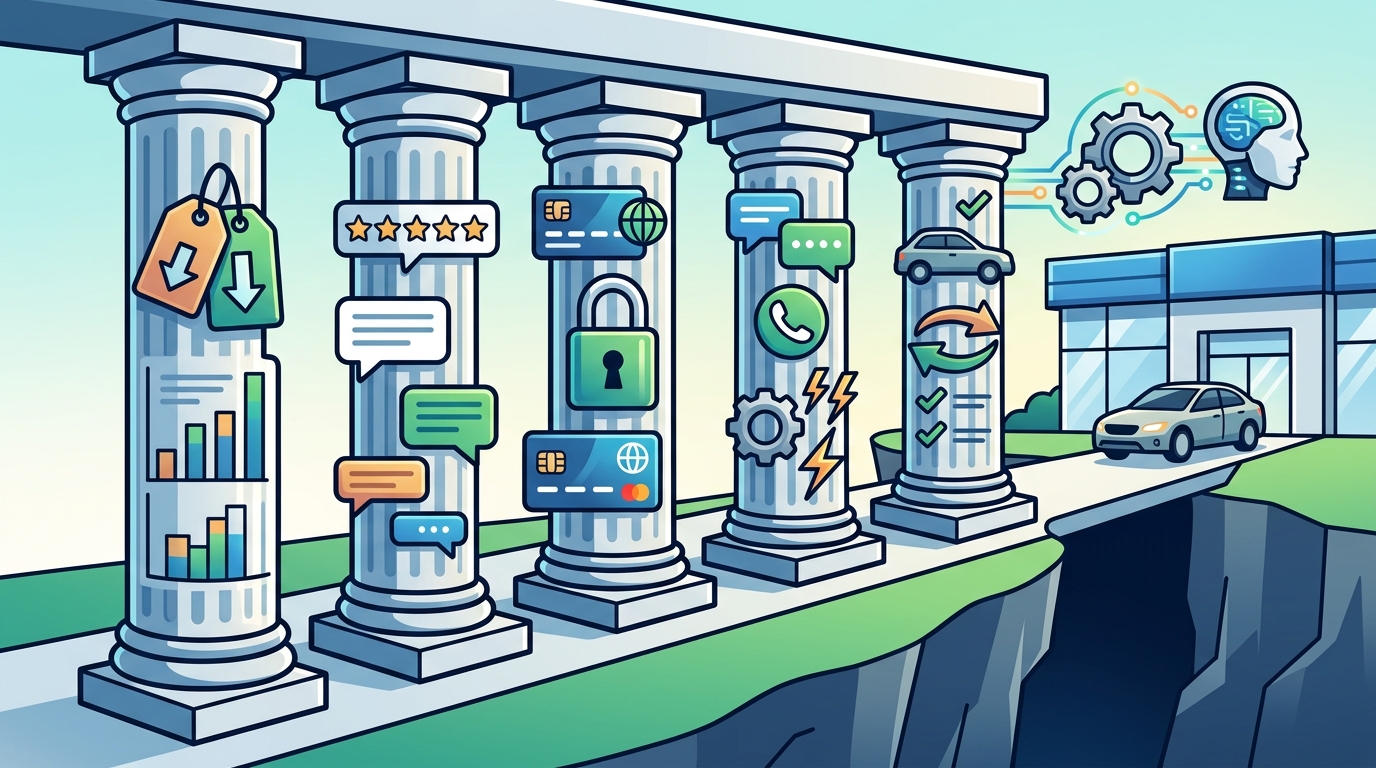
Dealerships build customer trust by combining transparent pricing, secure payment methods, and rapid, personalized communication. Better Car People helps automotive dealerships enhance trust by leveraging collaborative intelligence to ensure every customer interaction is fast, accurate, and human-centered. This guide covers five core strategies: transparent pricing, customer reviews, payment security, responsive support, and return policies.
Transparent Pricing
Transparent pricing is the practice of providing clear, upfront, and consistent cost information to customers before they commit to a purchase. In the automotive industry, hidden fees and fluctuating out-the-door prices are the primary drivers of buyer anxiety. When a dealership hides costs until the final signature, it erodes the foundation of trust required for a long-term relationship.
The Cost of Opaque Pricing
Customers today are more informed than ever. They research online and compare prices across multiple dealerships. If a dealership's final price differs significantly from the advertised price, the customer feels deceived. This perception of a "bait and switch" tactic leads to deal abandonment and negative word-of-mouth. To build trust, dealers must align their digital advertising with their in-store reality. according to How to Leverage For additional details, review the Case Studies Better Car.
Implementing Price Clarity
Dealerships should adopt a "no-surprises" policy. This involves listing all mandatory fees, such as documentation and destination charges, on the vehicle's listing page. By using automated systems to keep digital prices synchronized with the Management Information System (MIS), dealers ensure that the price a customer sees online is the price they pay at the desk. This consistency signals honesty and respect for the customer's time.
Customer Reviews
Customer reviews are public testimonials that reflect the actual experiences of previous buyers and service clients. In the digital age, a dealership's online reputation is its most powerful trust signal. Prospective buyers often treat third-party review platforms as a neutral arbiter of quality. A high volume of positive reviews validates a dealership's claims, while a lack of reviews or a pattern of negative feedback creates immediate skepticism.
Managing the Review Cycle
Building trust through reviews requires a proactive strategy. Dealerships must ask for reviews at the moment of peak satisfaction, typically after a successful sale or a well-handled service repair. However, it is equally important to address negative feedback. A professional, empathetic response to a critical review demonstrates accountability. It shows potential customers that the dealership takes feedback seriously and is committed to resolving issues.
Leveraging Social Proof
Dealers should highlight specific, detailed reviews on their website. Generic praise is less convincing than a review that mentions a specific employee or a specific problem that was solved. By curating these stories, dealerships create a narrative of reliability. This social proof acts as a bridge between the dealership's marketing claims and the customer's desire for a safe, predictable buying experience.
Payment Security
Payment security is the set of technical and procedural measures that protect a customer's financial data during a transaction. When customers enter sensitive information like credit card numbers or bank details, they are vulnerable to fraud. A dealership that prioritizes security demonstrates that it values the customer's financial well-being as much as the sale itself. Trust is fragile; a single data breach or a clumsy handling of payment information can destroy a dealership's reputation.
Modernizing Payment Infrastructure
Dealerships must ensure their point-of-sale systems are up to date with the latest encryption standards. Offering multiple payment options, including digital wallets and contactless payments, reduces the risk of data exposure. Furthermore, the physical environment of the finance office should reflect this security. Using secure, private spaces for signing documents and ensuring that screens are not visible to others reinforces the message that the dealership is a safe place to conduct business.
Communicating Security Protocols
Security is not just about technology; it is about communication. Dealers should explicitly state their security protocols on their website and in their contracts. Explaining how data is encrypted and who has access to it helps demystify the process for the customer. This transparency turns a potential anxiety point into a demonstration of professional competence.
Responsive Support
The Role of Speed in Trust
Speed is a proxy for respect. When a customer sends an email or text and receives a response within minutes, it validates their interest. Better Car People utilizes AI-powered engagement to ensure that no lead is left waiting. By combining the speed of AI with the nuance of human agents, dealerships can provide 24/7 responsiveness. This constant availability reassures customers that they are not just a number in a database but a priority for the team.
Personalization and Empathy
Return Policies
A return policy is a formal agreement that outlines the conditions under which a customer can return a product or service. In the automotive industry, return policies are often limited due to the nature of the product. However, the clarity of these policies is crucial for trust. If a dealership is vague about its return or exchange options, customers will assume the worst. A clear, fair, and well-communicated policy reduces the perceived risk of the purchase. according to Weathering the crash
Clarity in Contractual Terms
Post-Purchase Reassurance
Trust is not only built during the sale but also after it. Following up with the customer after the purchase to ensure they are satisfied with the vehicle reinforces the dealership's commitment. If a customer has a minor issue, a dealership that is willing to work with them to find a solution, even if it is not a formal return, builds immense loyalty. This post-purchase care transforms a one-time transaction into a lifelong relationship.
Comparison of Trust Strategies
| Strategy | Primary Trust Driver | Implementation Focus |
|---|---|---|
| Transparent Pricing | Honesty | Aligning digital ads with final prices |
| Customer Reviews | Social Proof | Proactive review generation and response |
| Payment Security | Safety | Modern encryption and clear communication |
| Return Policies | Low Risk | Plain-language terms and post-purchase care |
Key Takeaways
- Transparent pricing eliminates the "bait and switch" perception that erodes buyer confidence.
- Customer reviews serve as neutral social proof, validating a dealership's quality claims.
- Payment security builds trust by demonstrating respect for the customer's financial data.
- Responsive support signals that the dealership values the customer's time and interest.
- Clear return policies reduce the perceived risk of a high-value purchase.
- Collaborative intelligence, combining AI speed with human empathy, is the most effective way to maintain trust across all channels.
- Trust is a cumulative asset built through consistent, honest, and fast interactions at every stage of the journey.
Frequently Asked Questions
How does fast response time impact customer trust?
Fast response times signal that a dealership is organized and respectful of the customer's time. In the automotive industry, where buyers often compare multiple options, the dealer that responds first and most clearly often wins the trust of the prospect. according to Customer Experience Management
Why are customer reviews important for new car buyers?
New car buyers are making a significant financial commitment. Reviews provide real-world evidence of a dealership's reliability and service quality, helping buyers feel confident in their choice.
What is the role of AI in building trust?
AI ensures that no customer inquiry goes unanswered, providing immediate acknowledgment. When combined with human follow-up, it creates a seamless experience that feels both efficient and personal.
How can dealerships make their pricing more transparent?
Dealerships should list all fees on their website and ensure that the advertised price matches the final price. Using automated systems to keep prices synchronized across all channels is essential.
Does a strict return policy hurt trust?
A strict policy is not inherently bad, but a vague one is. If a dealership clearly explains its return terms in plain language, customers are more likely to trust the process, even if the policy is limited.
How does Better Car People help with responsive support?
Better Car People provides a collaborative intelligence platform that uses AI to capture and respond to leads instantly, while empowering human agents to handle complex conversations with empathy and expertise.