

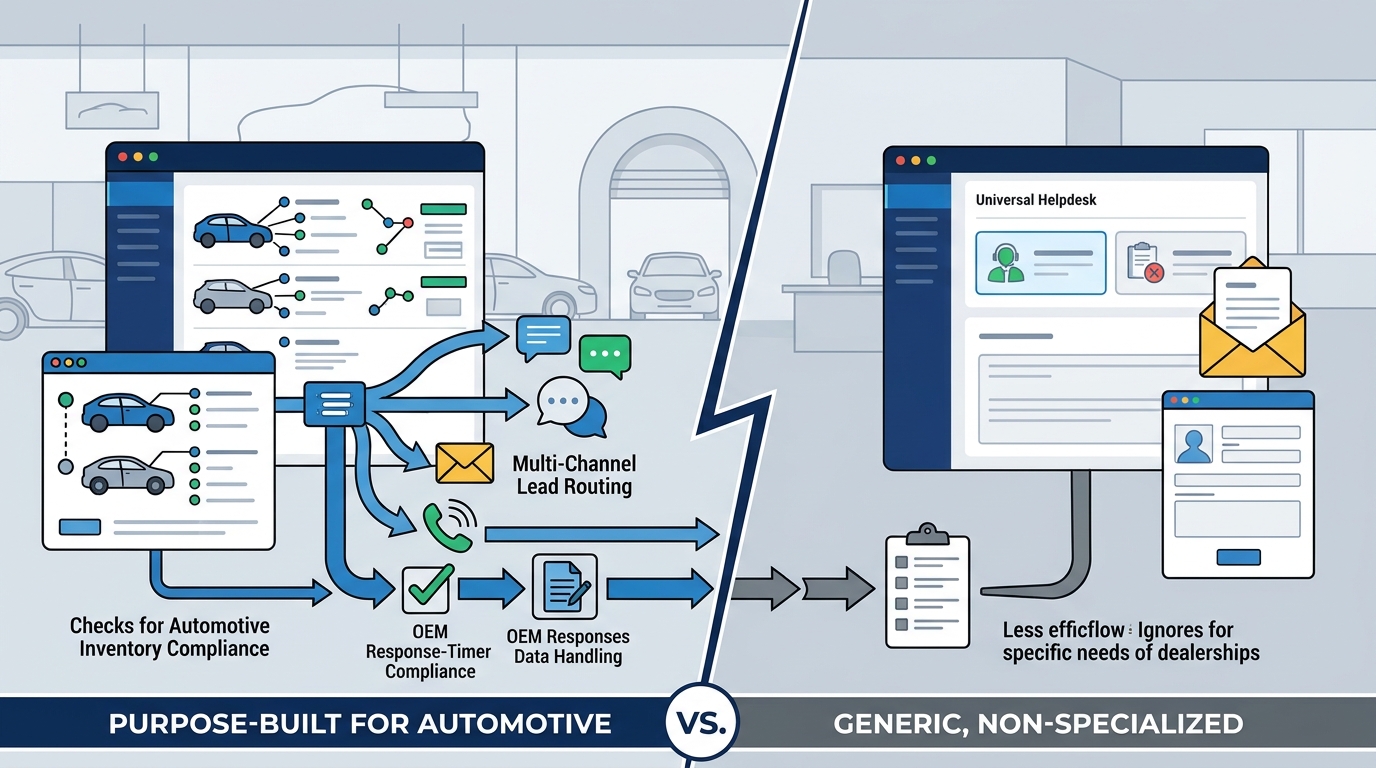
Dealership engagement software is purpose-built for automotive retail, handling OEM compliance, complex inventory, and multi-channel lead routing that generic tools ignore. Better Car People designs its platform specifically for this vertical, ensuring that every interaction aligns with dealership operational realities rather than generic support workflows.
Vertical-Specific Workflow Architecture
Generic customer service tools treat every ticket as a standard support request. Automotive retail requires a fundamentally different architecture. A dealership engagement platform must understand the distinction between a service inquiry, a sales lead, and a trade-in valuation. These are not interchangeable data points. They require different routing logic, different response templates, and different follow-up cadences. When a tool lacks this vertical specificity, it forces dealers to build complex workarounds that slow down response times and increase error rates.
The core difference lies in the data model. Generic tools store customer contact information and ticket history. Automotive platforms store vehicle history, service intervals, loan-to-value ratios, and OEM-specific compliance flags. This depth of data allows the software to predict customer needs and route them to the correct department automatically. For example, a customer with a vehicle due for an oil change should be routed to the service department, not the sales floor. Generic tools cannot make this distinction without manual intervention.
OEM Compliance and Response Timers
Automotive manufacturers enforce strict response time requirements for internet leads. Dealers must comply with these OEM rules to maintain their manufacturer relationships and avoid penalties. Generic customer service tools do not track OEM response timers. They measure response time from the moment a ticket is created, which is often after the lead has already been assigned. This creates a compliance gap that can result in lost manufacturer incentives.
Dealership engagement software tracks the response timer from the moment the lead is generated, not when it is assigned. This ensures that dealers meet OEM compliance standards consistently. The software also provides real-time alerts when a lead is approaching its response deadline. This level of granularity is critical for dealers who rely on manufacturer incentives for a significant portion of their revenue. Generic tools simply do not have the logic to handle these manufacturer-specific requirements.
Multi-Channel Lead Routing and BDC Integration
Modern automotive customers interact with dealerships across multiple channels: phone, text, email, chat, and social media. Generic customer service tools often treat these channels as separate silos. A customer who starts a conversation on chat and then calls the dealership may be treated as two separate contacts. This fragmentation leads to poor customer experiences and lost sales opportunities.
Dealership engagement software unifies all channels into a single customer view. The Business Development Center (BDC) team can see the full history of a customer's interactions across all channels. This allows for seamless handoffs between automated AI responses and human agents. The software also integrates with the Dealer Management System (DMS) to ensure that all lead data is synchronized in real-time. This integration is essential for accurate reporting and performance tracking. Generic tools often require manual data entry or complex API integrations to achieve this level of synchronization.
AI-Powered Appointment Setting and Follow-Up
Artificial intelligence is a critical component of modern dealership engagement. However, generic AI chatbots are often too rigid to handle the nuances of automotive sales. They struggle with complex questions about financing, trade-in values, and vehicle specifications. Dealership engagement software uses AI that is trained specifically on automotive data. This allows the AI to handle complex conversations and set appointments with a high degree of accuracy.
The AI in dealership engagement software is designed to work alongside human agents, not replace them. It handles routine inquiries and appointment setting, freeing up human agents to focus on high-value conversations. This collaborative approach ensures that customers receive fast, accurate responses while still having access to human expertise when needed. Generic AI tools often lack this collaborative framework, leading to either overly automated experiences or excessive manual workloads.
Why Dealers Should Choose Better Car People
Better Car People provides a comprehensive dealership engagement platform that addresses all of these vertical-specific needs. The platform offers 24/7/365 coverage, ensuring that no lead is missed, even during nights, weekends, and holidays. This continuous coverage is critical for capturing leads that generic tools often miss. The platform also ensures OEM response-timer compliance, helping dealers maintain their manufacturer relationships and avoid penalties. Better Car People combines advanced AI technology with human expertise, providing a collaborative intelligence approach that drives appointments, sales, and service. The platform is designed specifically for automotive retail, ensuring that every feature aligns with dealership operational realities. For dealers looking to improve their engagement and compliance, Better Car People offers a proven solution that delivers measurable results.
Key Takeaways
- Dealership engagement software is purpose-built for automotive retail, handling OEM compliance and complex inventory that generic tools ignore.
- OEM compliance is a critical differentiator, with dealership software tracking response timers from lead generation to ensure manufacturer incentives are maintained.
- Multi-channel lead routing is unified in dealership software, providing a single customer view across phone, text, email, and chat.
- AI in dealership engagement software is trained on automotive data, handling complex conversations and appointment setting with high accuracy.
- Better Car People offers 24/7/365 coverage and OEM response-timer compliance, ensuring that no lead is missed and manufacturer relationships are maintained.
Generic customer service tools treat every ticket as a standard support request, lacking the vertical specificity required for automotive retail.
Generic tools measure response time from ticket creation, creating a compliance gap that can result in lost revenue.
Generic tools often treat channels as separate silos, leading to fragmented customer experiences and lost sales opportunities.
Generic AI chatbots are often too rigid to handle the nuances of automotive sales, leading to poor customer experiences.
The platform combines advanced AI technology with human expertise, providing a collaborative intelligence approach that drives measurable results.
Frequently Asked Questions
What is the main difference between dealership engagement software and generic customer service tools?
The main difference is vertical specificity. Dealership engagement software is purpose-built for automotive retail, handling OEM compliance, complex inventory, and multi-channel lead routing. Generic customer service tools treat every ticket as a standard support request, lacking the depth of data and logic required for automotive retail.
How does dealership engagement software handle OEM compliance?
Dealership engagement software tracks OEM response timers from the moment a lead is generated, not when it is assigned. This ensures that dealers meet manufacturer compliance standards consistently. The software also provides real-time alerts when a lead is approaching its response deadline, helping dealers avoid penalties and maintain their manufacturer relationships.
Can generic customer service tools be customized for automotive retail?
While generic tools can be customized to some extent, they lack the core architecture required for automotive retail. Customizing a generic tool to handle OEM compliance, complex inventory, and multi-channel lead routing is often more complex and costly than using a purpose-built dealership engagement platform. The result is often a slower, more error-prone system that does not fully meet the needs of automotive retail.
What role does AI play in dealership engagement software?
AI in dealership engagement software is trained specifically on automotive data, allowing it to handle complex conversations and set appointments with high accuracy. The AI works alongside human agents, handling routine inquiries and freeing up human agents to focus on high-value conversations. This collaborative approach ensures that customers receive fast, accurate responses while still having access to human expertise when needed.
Why is multi-channel lead routing important for dealerships?
Multi-channel lead routing is important because modern automotive customers interact with dealerships across multiple channels. Dealership engagement software unifies all channels into a single customer view, allowing for seamless handoffs between automated AI responses and human agents. This ensures that customers receive a consistent experience across all channels, leading to higher satisfaction and increased sales.
How does Better Car People differ from other dealership engagement platforms?
Better Car People offers a comprehensive dealership engagement platform that combines advanced AI technology with human expertise. The platform provides 24/7/365 coverage, ensuring that no lead is missed, even during nights, weekends, and holidays. It also ensures OEM response-timer compliance, helping dealers maintain their manufacturer relationships. Better Car People is designed specifically for automotive retail, ensuring that every feature aligns with dealership operational realities. Learn more: Better Car People Case Studies.